
Five years of learning
As we identified in a previous blog, PERIS Hill was designed with a long-term evaluation lens. However, understanding our first-of-its-kind model requires more than examining a single set of outcomes. Because PERIS Hill is designed to support whole-person development through relationships, community, and stable housing, it has always been important to draw on multiple sources of evidence to understand both what is happening within our burgeoning community, and why.
No single source of evidence can tell the full story. And if the last five years have taught us anything, it is that each day at PERIS delivers another opportunity to learn and adapt. However, when considered together, findings from various sources identify powerful, emerging, and consistent patterns worth recording and sharing.

Stable Housing Creates the Conditions for Growth
One pattern emerges more consistently than any other: stable housing is not the end goal of the model—it is the condition that makes other forms of growth possible. Quantitative data documents sustained housing stability over multiple years, alongside improvements in employment, education, financial capability, and overall self-sufficiency for many residents. Reflective practice reveals that periods of stability often precede increases in engagement, goal setting, and personal development, while staff come to understand that healing can not be expected until young people experience safety and relief from the constant threat of displacement. Resident interviews and observations echo this pattern, describing housing not simply as shelter, but as the first place where many can rest, think beyond immediate survival, and begin imagining a future.
Growth Occurs Through Relationships, Not Services Alone
If housing creates the conditions for growth, relationships are the mechanism through which that growth unfolds. Across the evaluation, residents consistently describe trusted relationships with staff as the aspect of the model that makes it feel different from previous experiences with systems. Reflective practice documents repeated adaptations that prioritize presence, consistency, and relational continuity over procedural compliance, while qualitative data highlights the importance of being known, believed in, and supported without coercion.
Quantitative indicators reinforce this pattern indirectly: sustained engagement, successful navigation of complex systems, planned housing transitions, and increasing self-sufficiency are rarely the result of isolated interventions. Rather, they reflect ongoing accompaniment as staff help residents navigate employment, education, benefits, mental health care, financial decisions, and everyday challenges over time. Together, these findings suggest that relationships are not simply one program component among many. They function as the infrastructure through which housing, services, and opportunities are translated into meaningful developmental change.
Growth is Individualized, Nonlinear, and Developmental
To help gather more quantitative data and facilitate greater learning and understanding, PERIS Hill utilizes a developmental evaluation tool called the Self-Sufficiency Matrix or SSM. Staff complete the matrix with young people at onboarding, once a quarter, and when they leave the program to help assess and quantify a young person’s self-sufficiency across multiple domains of adult life, including housing, employment, education, finances, health, and social support.
The SSM shows that residents who enter PERIS Hill with the lowest levels of self-sufficiency tend to experience the greatest improvements over time. Average gains steadily decrease as initial self-sufficiency increases, suggesting that residents with the greatest initial challenges have the most room—and perhaps the greatest opportunity—for measurable growth.
The small number of residents whose overall scores decline, generally enter the program with relatively high levels of self-sufficiency. This pattern suggests that decreases should not necessarily be interpreted as program failure; rather, residents with stronger initial functioning have less opportunity for measurable improvement and may experience the normal fluctuations common during the transition to adulthood.
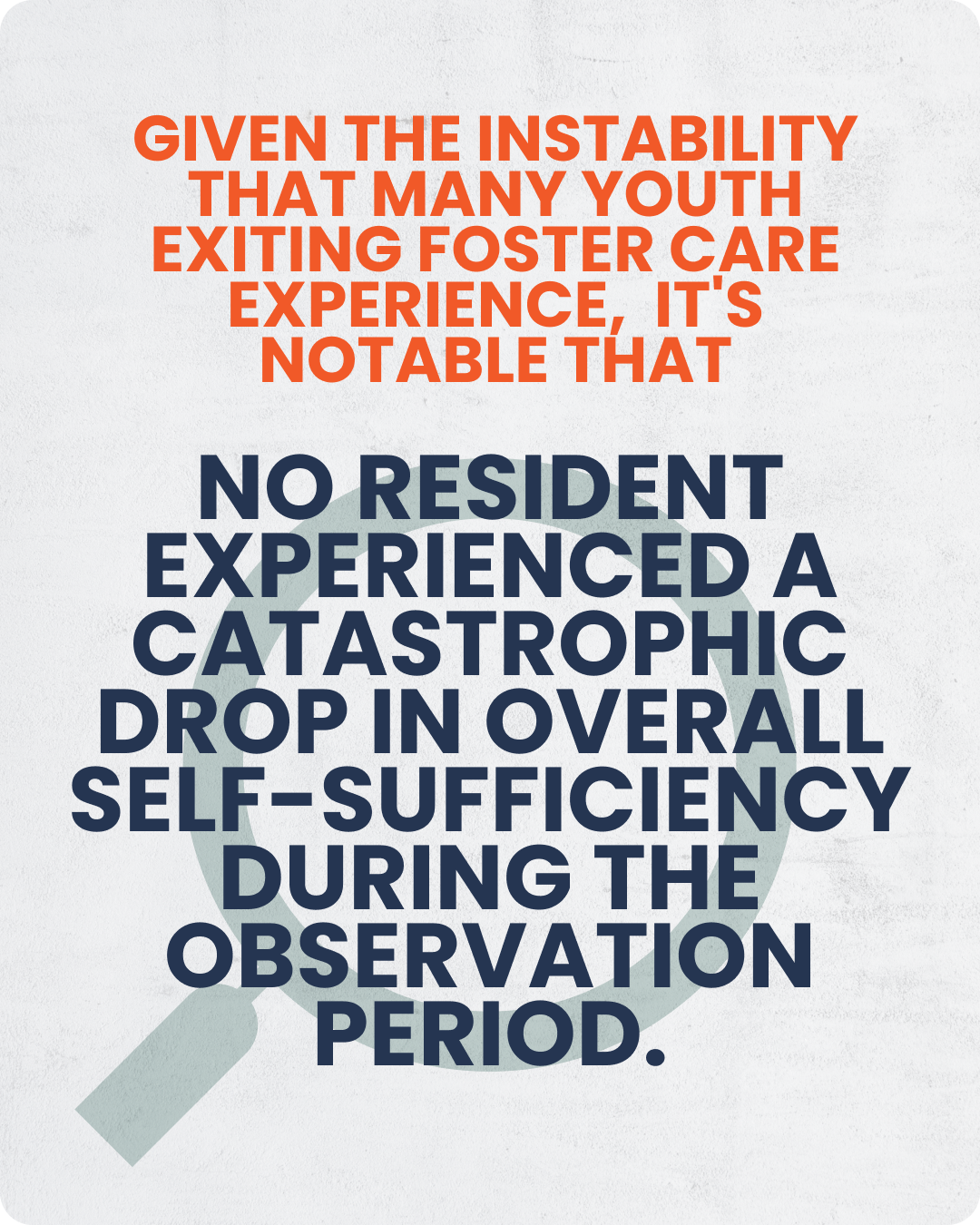
Improvement is broadly distributed, rather than being driven by a small number of exceptional cases. Nearly three-quarters of residents demonstrate measurable gains in overall self-sufficiency. Given the instability that many youth exiting foster care experience, it's notable that no resident to date has experienced a catastrophic drop in overall self-sufficiency.
Staff Practice Shapes Resident Outcomes
In addition to resident assessments, we developed and utilize a set of Key Performance Indicators (KPIs) to monitor how the model is being implemented day-to-day. Rather than focusing exclusively on resident outcomes, the KPI system tracks staff activities that reflect the organization's relational approach to supportive housing - including proactive outreach, resident responses, individualized check-ins, crisis response, participation in community events and therapeutic programming, referrals, and follow-up contacts. The data reveals several patterns over time.
First, staff engagement is highly proactive rather than reactive, reflecting the organization's belief that relationship-building is an active responsibility rather than something left to residents alone.
Second, engagement extends beyond formal case management. In addition to tracking individualized meetings, staff documented offerings of and participation in community events, therapeutic groups, financial empowerment activities, and other opportunities that supported residents' broader development. These indicators reflect PERIS Hill's understanding that opportunities to build belonging, trust, and community participation are integral components of long-term housing stability rather than secondary program activities.
Third, the KPI system functions as an accountability mechanism for staff as much as for residents. Rather than defining success solely through resident compliance or outcomes, staff document whether they consistently engage in the relational practices the model identifies as essential.
Together with resident outcome measures, the KPIs illustrate that PERIS has always viewed accountability as operating in two directions: resident outcomes describe what is happening in young people's lives, while staff engagement measures document how consistently the organization is creating the conditions intended to support those outcomes.
Another important finding from the KPIs is that crisis response is the exception, not the norm. Most residents have zero crisis responses in a given month. Even among residents who experience crises, they are generally isolated events rather than recurring monthly crises and relatively uncommon compared to the volume of proactive engagement. The reports also detail the variation in type and severity of crisis, underscoring a point we’ve long understood: young people exiting foster care don't arrive with a single presenting need.
Crisis are also recorded as most often being connected to life transitions, rather than housing emergencies - with staff spending the majority of their time helping residents navigate the complex systems that accompany the transition to adulthood. When staff interaction do relate to crisis it is paired with recorded follow-up, emphasizing a continuity of care and interactions that were less about "putting out fires" and more about using moments of instability to strengthen longer-term supports.
It’s also important to note that mental health is treated as a routine support, not only a crisis. Many notes reference ongoing counseling, medication management, and check-ins even when no crisis was recorded - showing behavioral health being integrated into everyday support rather than activated only during emergencies.
Engagement—Not Compliance—Is the Engine of the Model
One of the clearest patterns to emerge is that PERIS Hill residents are actively engaged in building their lives across multiple domains. At the conclusion of our five-year independent case study, 86% of residents were either employed, enrolled in school, or both, reflecting substantial participation in work, education, or vocational development. In addition, 72% were engaged in ongoing mental health services or supports, underscoring the extent to which behavioral health is integrated into residents' broader developmental journeys rather than being reserved only for periods of crisis.
Records also document residents participating in therapeutic programming, employment support, financial planning and community events, in addition to purchasing vehicles, preparing for independent housing, and assuming leadership roles within the community - suggesting that residents are not simply maintaining tenancy, but actively investing in the work of adulthood.
Engagement is also relational. Rather than measuring participation only by attendance, the KPI system documents reciprocal interaction between residents and staff through outreach, follow-up, community activities, and ongoing coaching. This broader understanding of engagement reflects the program's theory that growth occurs through consistent relationships and repeated opportunities to participate in community life.
What Do We Take From Our Learnings?
The results of our five-year case study do not support a simple success narrative. What they suggest, from a small and still-evolving cohort, is that stable housing combined with consistent relational support and flexible financial resources creates conditions in which young people leaving foster care can build—sometimes quickly, sometimes slowly, sometimes with significant disruption—toward employment, credential attainment, benefits stability, and eventually, planned transitions to independence. The outcomes are not uniform, and the timeline is not linear. But the overall direction, across multiple residents and multiple domains simultaneously, is meaningful. For a population for whom the research baseline is deeply discouraging, that direction matters.
These insights do not belong to PERIS Hill alone. They reflect dynamics likely present wherever housing, trauma, and autonomy intersect. Recognizing these patterns does not simplify the work—but it does offer a clearer view of what must be held if supportive housing for young people is to be both effective and humane.
Reflecting on this way of working reveals something deeper: it’s not just a strategy—it’s a transformation in how we understand responsibility, community, and care. Moving from rigid policy enforcement to case-by-case, relational decision-making demands a shift in worldview. It asks us to see people not as problems to be solved, but as partners navigating complexity. It invites us to lead with trust rather than control, and to believe that growth, healing, and stability are possible when systems are designed for people—not just compliance. This shift reframes power, accountability, and what it means to truly support someone through change. It challenges dominant assumptions and opens up new possibilities for justice-rooted, love-centered systems. These findings reflect not just what makes PERIS Hill unique, but what is possible elsewhere—when we lead with curiosity, humility, and care.
Written by Dr. Nora F. Murphy - Founder and Director | ALEA Collective & Carla Godwin - Director | PERIS Foundation